About Liquid War — an army that follows your cursor
Liquid War — an army that follows your cursor is a free online Strategy game that runs right in your browser. There is nothing to download and no account to create: press Play and you are in. It works on desktop, laptop, tablet and mobile.
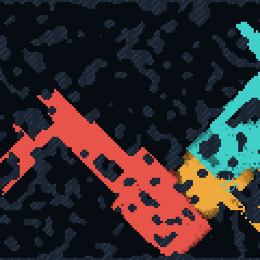
Your army is a few thousand fighters and you command none of them: you move one cursor, and every fighter of your colour floods through the maze along the shortest path to it. When two colours meet nobody dies — the loser changes sides, so the map is a tug of war over one fixed population and every fight you win makes you bigger. Feed a corridor one fighter at a time and you hand it over; pull back until the queue bunches up and arrive all at once, and you take it. Seeded battlefields in six shapes, up to four armies, five opposing temperaments and a twelve-battle ladder that bends one rule at a time.
How to play
Press the Play button to load the game. Most games are played with the mouse or by tapping the screen; keyboard games use the arrow keys, WASD or the space bar. Read the in-game instructions for the exact controls, and use the fullscreen button for the best experience.
Frequently asked questions
Is Liquid War — an army that follows your cursor free?+
Yes. Liquid War — an army that follows your cursor is completely free to play in your browser. You do not need to download anything or create an account.
Can I play Liquid War — an army that follows your cursor on my phone?+
Yes. Liquid War — an army that follows your cursor works in modern mobile browsers on iPhone, iPad and Android phones, as well as on Windows, Mac, Linux and Chromebook computers.
Is my progress saved?+
Scores and progress are stored locally in your browser on this device. Clearing your browser data will reset them.
Who made Liquid War — an army that follows your cursor?+
Liquid War — an army that follows your cursor is an open-source game by Tobias Müller (GPTGames), published under the MIT license.
Credits
Created by Tobias Müller (GPTGames). Open source under the MIT license. Source code ↗