Über Strata — a falling-sand world you have to discover
Strata — a falling-sand world you have to discover ist ein kostenloses Simulation-Spiel, das direkt in deinem Browser läuft. Kein Download, kein Konto: einfach auf Spielen drücken und loslegen. Funktioniert auf PC, Laptop, Tablet und Handy.
Spielbeschreibung
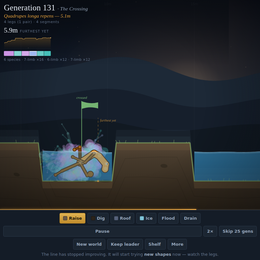
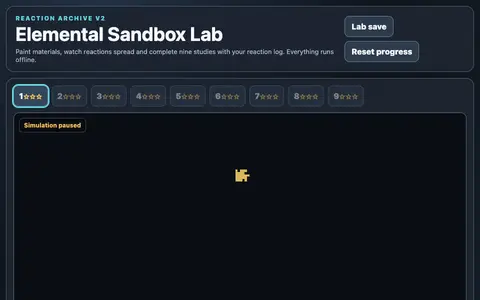
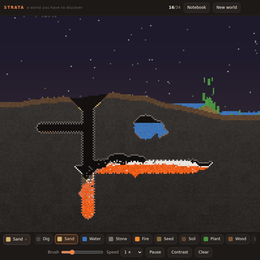
A falling-sand sandbox with no palette. You start with sand, water, stone, fire and a seed; the other twenty-nine materials have to be found. Quench lava to get obsidian, let steam climb until it snows, bury a plant deep under stone and come back to find oil, then coal, then diamond. The ground is opaque until you cut into it, so the salt seams, the ore and the magma at the bottom are yours to dig out. Nothing is discovered for you. Slow the world to an eighth speed to watch a reaction happen, or switch on high-contrast colours to tell the greys apart. Your notebook is kept between worlds.
So wird gespielt
Drücke auf Spielen, um das Spiel zu laden. Die meisten Spiele steuerst du mit der Maus oder per Touch; Tastaturspiele nutzen die Pfeiltasten, WASD oder die Leertaste. Die genaue Steuerung steht in der Anleitung im Spiel. Im Vollbild macht es am meisten Spaß.
Häufige Fragen
Ist Strata — a falling-sand world you have to discover kostenlos?+
Ja. Strata — a falling-sand world you have to discover ist komplett kostenlos und läuft im Browser. Du musst nichts herunterladen und kein Konto anlegen.
Kann ich Strata — a falling-sand world you have to discover auf dem Handy spielen?+
Ja. Strata — a falling-sand world you have to discover läuft in aktuellen mobilen Browsern auf iPhone, iPad und Android sowie auf Windows-, Mac-, Linux- und Chromebook-Computern.
Wird mein Fortschritt gespeichert?+
Punktestände und Fortschritt werden lokal im Browser auf diesem Gerät gespeichert. Wenn du die Browserdaten löschst, werden sie zurückgesetzt.
Wer hat Strata — a falling-sand world you have to discover entwickelt?+
Strata — a falling-sand world you have to discover ist ein Open-Source-Spiel von Tobias Müller (GPTGames), veröffentlicht unter der MIT-Lizenz.
Credits
Entwickelt von Tobias Müller (GPTGames). Open Source unter der MIT-Lizenz. Quellcode ↗